

Sorry, your browser is not compatible with this application. Please use the latest version of Google Chrome, Mozilla Firefox, Microsoft Edge or Safari.
IoT Content

Fortinet and Armis from ServiceNow: Better...
This webinar insights brief highlights how Fortinet and Armis from ServiceNow work together to improve cybersecurity across critical infrastructure environments. The discussion explores how organizations can gain comprehensive visibility into…
Learn More

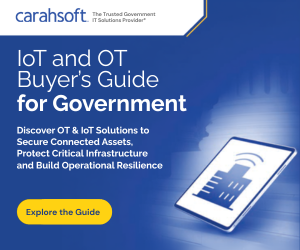
IoT and OT Buyer’s Guide for Government
The IoT and OT Buyer’s Guide for Government examines technologies that help public sector organizations securely connect, monitor, and manage devices across mission-critical environments. Produced by Carahsoft, the guide covers…
Learn More
The Converged Infrastructure Forensics Model...
Modern cyber incidents increasingly occur across interconnected ecosystems spanning cloud platforms, telecommunications networks, edge systems, IoT/IIoT devices, and operational technology. Traditional host-centric forensic methodologies are insufficient for reconstructing adversary activity…
Learn More
The Bill of Materials Crisis: Why 2019’s Research...
A critical software supply chain vulnerability affecting billions of devices highlights the dangers of treating security as a compliance exercise rather than an engineering discipline. This white paper examines the…
Learn More
Strengthening Cyber Resilience for Critical...
State and local governments sit at the heart of critical infrastructure protection, facing rising cyber threats against systems that power water, energy, transportation, and healthcare. This overview emphasizes the need…
Learn More
The 60-Minute Blind Spot
This white paper examines how ephemeral cloud provisioning for autonomous AI agents introduces new cybersecurity risks across operational technology (OT), industrial control systems (ICS), and post-quantum cryptography (PQC) initiatives. It…
Learn More
Whole Community Preparedness in Smart Cities and...
This NIST publication explores how modern threat actors exploit increasingly interconnected systems—especially multicloud environments, IoT devices, and edge platforms. It highlights real-world attack patterns, showing how adversaries move laterally across…
Learn More
Principles for the Secure Integration of...
This guidance outlines foundational principles for safely integrating artificial intelligence into operational technology environments. It explains how AI can enhance efficiency and decision-making while also introducing new risks related to…
Learn More
Growing Use Cases for the Ever-Evolving Digital...
Digital twin technology is expanding rapidly, bridging the physical and digital worlds to improve design, operations, and decision-making. By integrating AI, IoT, and analytics, organizations can simulate real-world assets to…
Learn More
2025 State of Operational Technology and...
Operational Technology (OT) environments are becoming more connected—and more exposed—to cyber threats. Fortinet’s report reveals that organizations are maturing in both process and solution adoption, with more CISOs taking ownership…
Learn More
OT Cyber Readiness in 90 Days
Operational Technology systems that power critical infrastructure—like federal facilities, utilities, airports, and data centers—face mounting cyber risk from ransomware and nation-state actors. Minerva Cyber’s OT Cyber Readiness in 90 Days…
Learn More
The NIST Cybersecurity Framework 2.0
The NIST Cybersecurity Framework 2.0 provides a comprehensive structure for managing cyber risk through governance, identification, protection, detection, response, and recovery. It expands on earlier versions with greater emphasis on…
Learn More